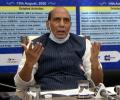
'The much-awaited decision could be a welcome change at a time when the Indian armed forces are crying for self-reliance and the defence industry is looking forward to more indigenisation,' notes Nitin A Gokhale.
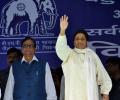
If Muslims back Mayawati, nothing can stop her from forming the next government in UP.

Gurung is worth his weight in gold to the BJP which is trying hard to make inroads in West Bengal

The going is not going to be easy for the DMK and its allies in Elections 2024. Despite the seats sweepstake in the 2021 assembly polls, the vote-share difference of 5.6% (DMK's 45.38% versus AIADMK-BJP's 39.72%) is not insurmountable on a bad day, points out N Sathiya Moorthy.

'The skills and abilities of civil servants are still respected, even though they become whipping boys when things go wrong.'

The seventh Tibet Work Forum was held in Beijing on August 28 and 29. Delhi should be deeply concerned, at a time India faces a precarious situation in Ladakh, because the TWF also defines China's western border policies, observes Claude Arpi.

Pakistan perceives that if it had declared Gilgit-Baltistan, PoK or both, which are only a part of the territories of J&K, as legitimate provinces of Pakistan it would weaken its case for the entire J&K and lead to legal complications, observes Lieutenant General Syed Ata Hasnain (retd).

Both have been robustly muscular leaders who began as immensely charismatic politicians conveying an impression that they were makers of history, raring to go. Both have been hyperactive on the world stage. But in the final analysis, Abe is departing on a sombre note, unceremoniously and apologetically, observes Ambassador M K Bhadrakumar.

It will not be to India's advantage to create misperceptions that it is bandwagoning with some Anglo-American project for regime change in Myanmar, argues Ambassador M K Bhadrakumar.

'The surge of Saudi nationalism is the last thing Washington wants,' says Ambassador M K Bhadrakumar.

'The logical step is to challenge the very legitimacy of the Chinese claim over Tibet,' recommends Inspector General Gurdip Singh Uban (retd).

Suresh Prabhu must first work to repair damage to railways.
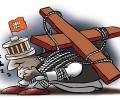
'Poor home work, and a subsequent loss of nerve.' 'This sums up the Modi government's current travails, the stall in key sectors, fading momentum, irritability,' points out Shekhar Gupta.

'We have a common way of looking at the world, a common way of thinking, and a common set of values that predispose us to be partners. And our interests overlap greatly,' Dr Ashton B Carter, America's next defence secretary, told Aziz Haniffa/Rediff.com in an exclusive interview.

'Unlike the Chinese army that has been largely a peace time force, the Indian Army is a battle hardened force,' explains Colonel Anil A Athale (retd).
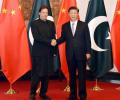
'The scheduling of Imran Khan's visit to Beijing and its focus on the J&K situation underscores that Beijing shares the Pakistani concern that tensions with India are only going to escalate further in the period ahead,' says Ambassador M K Bhadrakumar.
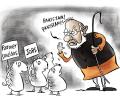
'India serves itself poorly with its latter-day discovery of Pakistan as an instrument in domestic politics,' notes Shekhar Gupta.
.jpg)
The Keynesian advice comes after Finance Minister P Chidambaram has said he considers the fiscal deficit at 4.8 per cent of gross domestic product in 2013-14 as a 'red line'.

An expert committee has recommended to Defence Minister Manohar Parrikar that supply of equipment need not be blocked even if bribery charges emerge.

With Beijing having had a profound rethink on India's admission as a full member of the Shanghai Cooperation Organisation, the tectonic plates of the geopolitics of a massive swathe of the planet stretching from the Asia-Pacific to West Asia are dramatically shifting. That grating noise in the Central Asian steppes will be heard far and wide -- as far as North America, says Ambassador M K Bhadrakumar.
Dr Talat Ahmad, vice chancellor of Jamia Milia Islamia suggests important reforms in the Indian education system.

The Chinese leader will display his grip on the Communist party and chart his plans for his country's future.

'A dangerous and false binary is now surfacing in Indian political discourse, which must be firmly rejected.' 'It is that we have to choose between freedom and development.' 'For us freedom is neither merely an instrument for development nor to be subordinated to development.' 'It is, as our founding fathers proclaimed early in our freedom struggle, 'our birthright' on which we shall never compromise.' 'Growth, wealth and development are fruits of democracy, not substitutes.' Dr Manmohan Singh's thoughts on democracy: A Must Read!

Fencing the border between Myanmar and Nagaland is expected to adversely affect the Naga tribals. Gautam Sen, an expert on Nagaland, explains why the Indian government needs a more comprehensive and long-term perspective on this issue and why it must take local tribal sensitivities and customs into account.

Pulwama must become the defining moment in our fight against terror, effecting a sea change in our mindset. The erratic, blow hot blow cold approach, the hallmark of our anti-terror-Pak-Kashmir policy must end. In its place is required a pragmatic, comprehensive, robust hard line course that is relentlessly pursued even in times of relative calm until the final objective is met, namely the eradication of separatism and the total annihilation of terror, says Vivek Gumaste.

'This novel format of diplomacy -- the informal summit -- will not only facilitate bilateral communication and reduce miscalculations at the very top level of the two governments, but possibly open the space for China and India to speak in one voice on various issues of mutual concern,' note Feng Renjie and Ding Kun Lei
'In India a strong leader with a majority has never yet been defeated by a challenger.' 'He (or she, as with Indira Gandhi in 1977) must defeat himself,' says Shekhar Gupta.

Without the handsome receipts from the sale of government equity in PSUs and sharp increases in excise revenues from oil, Mr Jaitley's fiscal consolidation drive would have become even more arduous, says A K Bhattacharya.
.jpg)
Beating of war drums, would further accord primacy to the army in Pakistan. A better approach would be to continue the talks for normalisation of trade relations, while giving the Indian forces autonomy to strike at militant camps across the LoC, says Alok Bansal
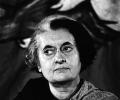
'According to me, her finest hour was in 1983-1984 when she neutralised a combined US-Pakistan-British conspiracy to Balkanise India by creating an independent Sikh State of Khalistan,' says Colonel Anil A Athale (retd). A special assessment of Indira Gandhi on her centenary.
This quiet assertion of China has allowed various smaller countries of South Asia to play China off against India. Most states in the region now use the China card to balance against the predominance of India. Forced to exist between their two giant neighbours, the smaller states have responded with a careful balancing act, says Harsh V Pant.
.jpg)
Throughout a quarter century of proxy war, India has shown tremendous restraint in the face of grave provocation. It is inconceivable that any other nation would have refrained from launching trans-LoC operations to eliminate terrorist training camps and interdict known routes of infiltration, says Brigadier Gurmeet Kanwal (retd).

'China's excessive military aid to Pakistan is the real elephant in the room as far as Sino-Indian relations are concerned. India should be confident enough to accept a degree of closeness between China and Pakistan, since China may wish to use this link for its foray into the Muslim world.' 'But the Chinese must be realistic enough to know that as time passes, the tactic of using Pakistan as a proxy to check India will yield diminishing returns. The US tried it for 60 years but failed, so will China,' says Colonel Anil A Athale (retd).

We must see New Delhi's position as a signal of competition to the Chinese grand design for the 21st century world, says Nitin Pai.

'He is seeking to harness the power of Indian Diasporas to national (support for India in global capitals) and political (enhance the Bharatiya Janata Party's support base) ends.'

Chaos in Parliament threw a spanner in the government's efforts to revive the economy and kick-start reforms.
'Somewhere along the way, elected office-bearers appeared to have lost sight of the interest of cricket and begun to pursue their own interpretation of what the game should be.' 'Families made it a tradition to have their representatives occupy, if not usurp, positions in state associations,' points out Vinod Rai, who will step down as head of the BCCI's Committee of Administrators on Wednesday, October 23.
'A three generation US-Pakistan relationship is not likely to be snapped any time soon. All this presents an irritant to an India that wishes to concentrate on economic development,' says Colonel Anil A Athale (retd).

New Delhi must indicate to Afghan President Ashraf Ghani that it has a long-term strategy for his country. It should point out that Pakistan's present Afgan policy will destabilise Afghanistan and help Islamic State, says Gautam Sen.
'Even if it is difficult to replicate Bangladesh, India can cause sufficient turmoil in Pakistan to keep it off balance,' says Colonel Anil A Athale (retd).
